Hoshanho Butcher Knife Set (8 Pieces, Walnut Wood Handle)
 Wakoli EDIS Damascus Knife Set (4-Piece, Grey)
 Wakoli EDIB Damascus Knife Set (5-Piece, Brown Pakkawood)
 Home Safety Damascus Knife Set (5 Piece, VG-10 Steel, Abalone Shell Handle)
 Kokoro Blade Infinity Edition Kiritsuke (8-Inch, Damascus Steel)
Modern Damascus knives start life as a stack of two or more different steels. The craftsmanship is all in how they're joined. The smith forge-welds them together, draws the billet out and folds it again and again until there are dozens of thin layers. That Damascus steel is then wrapped around a harder core and shaped into a knife.
The pattern only appears at the very end. An acid etch darkens one steel more than the other, so Damascus steel shows up as waves, ripples or tight raindrop swirls depending on how the billet was folded and cut.
The name goes back much further. Historic Damascus steel was a crucible steel known as wootz, first made in India and Sri Lanka. It was traded through the Near East and forged into swords with a pattern like flowing water. That original method was lost, so the Damascus steel knives you'll find today are pattern-welded instead. It's a different technique that gives a similar look.
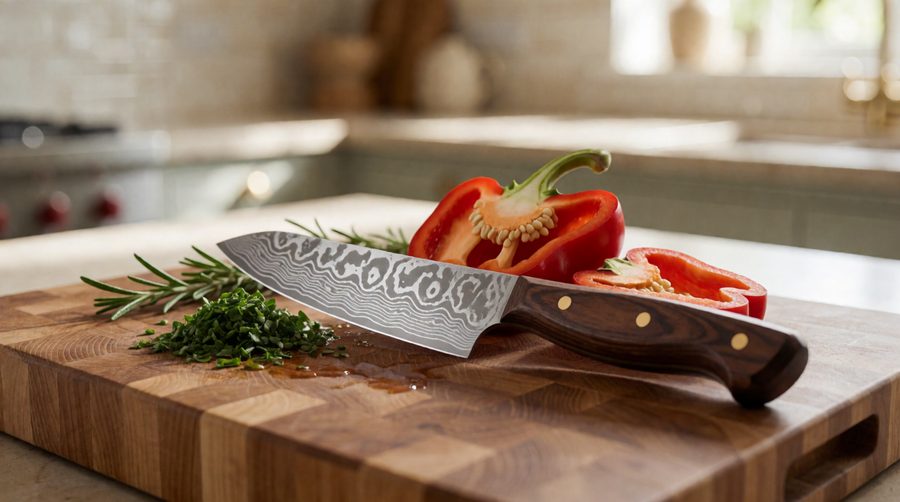
Mostly, yes, which is worth knowing before you buy. The cutting is done by the core steel that runs down the middle of the blade and is exposed right at the edge. On most Damascus kitchen knives that core is VG-10, a hard stainless Japanese steel that you'd also find on plenty of plain blades.
The outer Damascus steel cladding still earns its place. It's softer and tougher than the core, so it supports a hard edge that might otherwise be brittle. Many cooks also find thin slices of potato or cucumber cling a little less to a textured or hollow-ground blade.
So buy Damascus knives because you love the way they look and want a quality core underneath. Judge each one by the core steel, the hardness and the handle rather than the number of layers.
Here's how our Damascus knives and sets line up on the specs that matter, taken from each maker's own listing.
| Knife or set | Knives | Layers and core | Hardness | Edge | Handle |
|---|---|---|---|---|---|
| Wakoli EDIB | 5 (chef's, carving, two santoku, paring) | 67 layers, VG-10 core | 60±2 HRC | Double bevel, 15° | Pakkawood |
| Wakoli EDIS | 4 (santoku, carving, small santoku, paring) | 67 layers, VG-10 core | 60±2 HRC | Hollow edge, 15° | Pakkawood |
| Home Safety | 5 (chef's, santoku, bread, fillet, utility) | 67 layers, VG-10 core | 60±2 HRC | 12° double sided | Acrylic with abalone shell |
| Kokoro Blade Infinity Kiritsuke | 1 (20cm kiritsuke) | 110 layers, 10Cr15CoMoV and 9Cr18MoV | 60-62 HRC | Plain | Ebony and burl wood, octagonal |
Three of the four share the same recipe of 67 layers over VG-10 at about 60 HRC. That makes the real choice a question of blade shapes, handle and how many knives you want, rather than the steel.
VG-10 is the core you'll see most often in Damascus steel knives. It's a safe bet. It's stainless, it takes a fine edge and it holds it well. Look for a hardness of around 60 on the Rockwell scale (HRC). That's hard enough to stay sharp for weeks of everyday prep, yet not so hard that the edge chips the first time it meets a squash.
The Kokoro Blade sits a touch harder at 60-62 HRC. If edge keeping is top of your list, our sharpest chef knives include more of the hardest blades we stock.
Most of us reach for one or two knives for nearly every job. Think about what you cook before you count pieces.
A single chef's knife or santoku is the easiest way in. You get the same core steel and the same look on the knife you'll use most, then add others over time.
A Damascus knife set makes sense if you want every blade on the worktop to match. The Home Safety set is a good example, covering a 20cm chef's knife, an 18cm santoku, a 21cm bread knife, a 14.5cm fillet knife and a 12.4cm utility knife. For more sets in other steels, browse our chef knife set collection, or see our budget chef knives if you'd rather keep the spend down.
The handle is where knives in the same steel really differ. Pakkawood is wood bonded with resin, so it keeps the warmth of timber but copes far better with water. Octagonal Japanese handles, like the ebony and burl wood on the Kokoro Blade, sit snugly in a pinch grip and suit cooks who hold the blade rather than the handle.
Weight matters too, though lighter isn't always better. The Kokoro weighs 186g for a 20cm knife, which feels light and nimble next to a heavy German chef's knife. If you prefer a weightier, full-bolster feel, our Wüsthof chef knives are worth comparing.
Japanese-style Damascus knives are usually ground thinner than Western ones. The Wakoli sets are sharpened at 15 degrees. The Home Safety knives go finer still at 12 degrees. A narrower angle glides through food with less effort. The trade-off is a slightly more delicate edge, so save these blades for the board and keep them away from bones and frozen food.
Good care keeps Damascus steel looking crisp and the cutting line keen for years. None of it takes long once it becomes a habit.
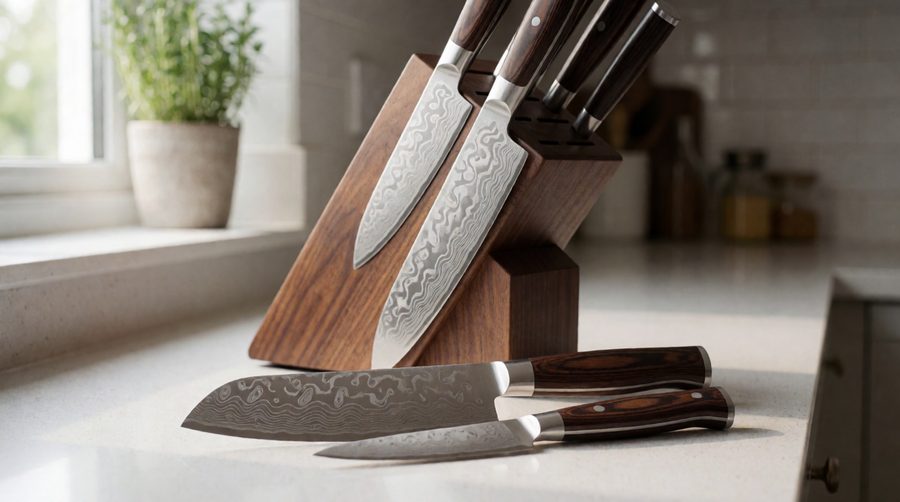
Sharpening Damascus steel is no different from sharpening any other Japanese knife. The pattern sits in the outer layers, while the stone works on the core steel at the edge. Use a whetstone at roughly the factory angle for precision, about 15 degrees per side on most of these. Then hone lightly between sessions. If you'd rather not freehand it, our professional knife sharpeners include guided systems that hold the angle for you.
Damascus steel makes a lovely present for a keen cook, partly because it looks so good out of the box. The Wakoli EDIB comes in a wooden presentation box. The Kokoro Blade arrives in an engraved black wooden box with a red lining.
Just remember the rules. It's illegal to sell most knives to anyone under 18 in the UK (in Scotland, 16 and 17 year olds can buy kitchen knives), so expect an age check on delivery. For more showpiece blades, see our expensive chef knives.
If you love the thin, hard Japanese style but don't mind a plain blade, our Japanese chef knives cover gyuto, santoku and nakiri from several makers. Global's one-piece stainless steel knives are another light, sharp option. You'll find them in our Global chef knives range.
For German heft, have a look at the Zwilling Pro chef knives. Or, if you just want the knives other cooks rate most highly, start with our top rated chef knives.
The good ones are excellent, but the credit goes to the core rather than the pattern. A VG-10 core at around 60 HRC under Damascus steel cladding cuts just like a plain knife made from the same core. You simply get a far more striking look and a little extra craftsmanship.
Those with a stainless core and stainless cladding, like the VG-10 knives here, resist rust well as long as you dry them after washing. Damascus steel made from carbon layers needs more care and can discolour, so check the listing before you buy.
It's best not to. All of the Damascus knives we list are hand wash only. A dishwasher can blunt the edge, dull the etched pattern and damage wooden or resin handles.
Not all of them. Most kitchen knives are made from factory-produced Damascus sheet or bar, then ground and finished in a workshop. Makers such as Sweden's Damasteel produce patterned stainless steel for knife makers. A few, like the Kokoro Blade kiritsuke, are sold as hand-forged.
Some cheap blades have the pattern laser-etched or printed onto a single piece of steel. On real layered steel the pattern runs right through the metal. You'll see it carry on along the spine and down to the edge rather than stopping neatly on the flat of the blade.
Not really, as layer counts of 67, 73 or 110 change the look of the Damascus steel, not how well the knife cuts. Compare the core steel, hardness and edge angle instead.