Edge Pro Apex 4 Knife Sharpening System
 KME Precision Knife Sharpener System KF-D4 (Gold Series, 4 Diamond Hones)
 Work Sharp Ken Onion Edition Elite MK.2 (Grey, Stainless Steel)
 Zwilling Four Star Self-Sharpening (Brown Ash Block, 7-Piece)
 Tormek T-1 Kitchen Knife Sharpener (Red Handle)
 Tormek T-1 Kitchen Knife Sharpener (Carbon Black)
Professional knife sharpeners put a keen, even edge back on chef's knives in minutes and keep doing it for years. This range covers quiet electric diamond wheel machines such as the Tormek T-1, belt grinders, rolling sharpeners and guided clamp systems that hold the angle to the degree.
They're for chefs who sharpen a full roll every week and for home cooks who've just spent good money on Japanese chef knives and want to keep them sharp. Pick by how often you sharpen, how much control you want and the angle your knives were made with.


A cheap pull-through gadget and a professional knife sharpener both remove steel. The difference is control. A good sharpener holds the same angle on every stroke, takes off only the steel it needs and leaves a clean, polished edge rather than a ragged one. Do that week after week and your knives stay sharp for longer and last far longer too.
In a busy kitchen, speed and noise matter as much as the edge. Tormek built its kitchen machines for exactly that job. The Tormek T-1 turns a fine diamond wheel slowly, so the blade never gets hot enough to lose its temper, and it runs at just 45 dB. Its bigger brother, the T-2 Pro, is used by the Swedish Culinary Team and in Michelin-starred kitchens.
There are six main styles of knife sharpening system. Each trades speed, precision and price in a different way, so it's worth knowing what you're looking at before you buy.
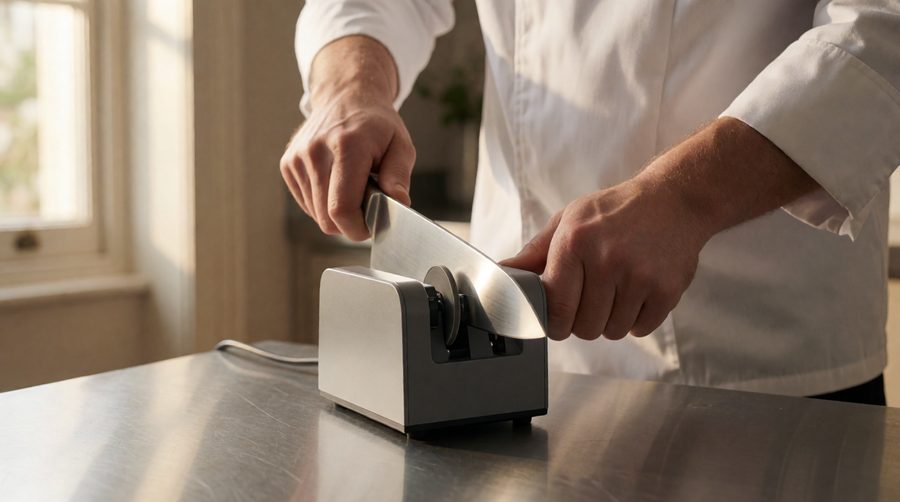
An electric knife sharpener is the quickest way through a whole knife roll. The Tormek T-1 uses its angle guide to set anything from 8 to 22 degrees per side, then a honing wheel polishes off the burr. The T-2 Pro takes a jig for kitchen scissors too. The F.Dick RS-75 is a heavy-duty German machine at 4.6kg, made for butchers' shops and catering. Graef's CX 110 is a smaller two-stage electric knife sharpener that converts a European 20° edge to a finer 15°.
A belt grinder such as the Work Sharp Ken Onion Edition Elite MK.2 removes metal fast and copes with chipped or badly worn blades. It sets 15-30° with its cassette and 10-35° freehand, and it handles scissors and garden tools as well as kitchen knives. The downsides are noise, dust and replacement belts, so it suits repairs and heavy use more than daily touch-ups.
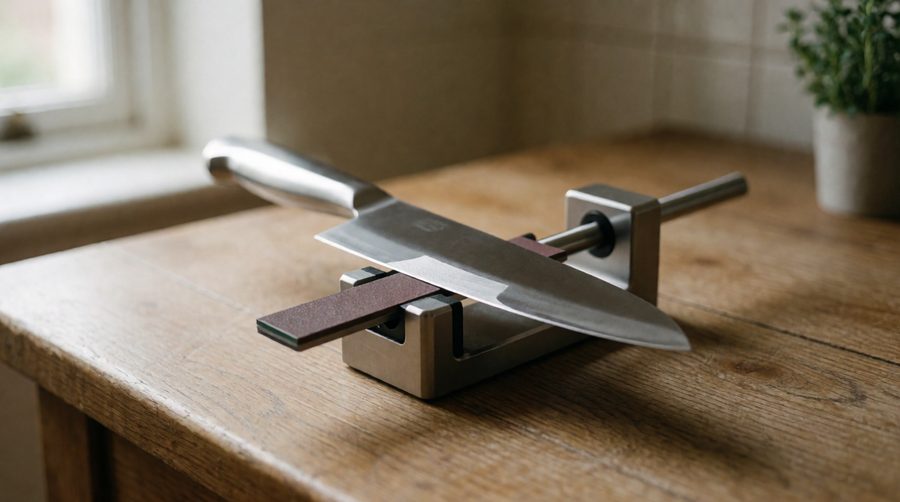
Here the blade is held still while you work a diamond stone on a rod at a set angle. Wicked Edge, KME, TSPROF and the Work Sharp Precision Adjust all work this way, and they give the most repeatable result of any manual knife sharpener. Lansky and Spyderco make simpler, cheaper rod kits that many people first learn on with pocket knives. One catch: the true angle depends on how far the edge sticks out of the vice, so mount each knife the same way every time.
The Edge Pro Apex 4 rests the knife on a flat table while you draw a water stone across it on a rod. There's nothing to tighten, so long, curved chef's knives are easy to follow. It comes with five stones from 120 to 1000 grit plus polishing tapes.
A rolling sharpener holds the knife on a magnetic block set at a fixed angle, and you roll a disc along the edge. Horl started the idea in Germany. They're simple, quiet and hard to get wrong, which makes them a good fit for home cooks who don't want to learn a whetstone.
Freehand whetstones give the finest finish but take practice to hold the angle. A pull-through knife sharpener is quick but less precise, and the fixed slots can take more steel than you'd like. Many chefs keep one for quick fixes and use a proper knife sharpening system for the real job.
We took these figures from the specs of every knife sharpener in our range, so you can compare like for like. Angles are per side of the blade.
| Sharpener | Type | Angle range | Abrasives | Power | Weight |
|---|---|---|---|---|---|
| Tormek T-1 | Electric wheel | 8-22°, stepless | Fine diamond wheel + honing wheel | Mains, 45 dB | 5.4kg |
| F.Dick RS-75 | Electric wheel | Not stated | Ultra fine diamond wheel | 75W | 4.6kg |
| Graef CX 110 | Electric, 2 stage | 15° | Diamond discs | 75W | 1.88kg |
| Graef CC120 | Electric, 3 stage | Fixed guides | Diamond discs + stropping disc | 45W | 2.04kg |
| Work Sharp Ken Onion Elite MK.2 | Belt | 15-30° guided, 10-35° grinding | Abrasive belts | Mains, variable speed | 3kg |
| Work Sharp Professional Precision Adjust | Guided clamp | 10-30°, 0.25° steps | Diamond 220-800, ceramic, strop | Manual | 810g |
| Wicked Edge Generation 4 Pro | Guided clamp | 12-28°, 0.5° steps | Diamond 100-1000 | Manual | 7.26kg |
| Wicked Edge GO WE60 | Guided clamp | 13-31°, 1° steps | Diamond 200/600 | Manual | 1.47kg |
| KME KF-D4 | Guided clamp | 17-30°, 1° steps | Diamond 140-1500 | Manual | 340g |
| TSPROF Pioneer | Guided clamp | 12-26° | 150mm stones, coarse to extra fine | Manual | 1.41kg |
| Edge Pro Apex 4 | Table | 10-24° | Water stones 120-1000 + tapes | Manual | 454g |
| Horl 2 Pro | Rolling | 15° and 20° | Diamond + ceramic discs | Manual | 1.37kg |
| Parkway Home rolling kit | Rolling | 10-40° | Diamond, ceramic, corundum 400-6000, strop | Manual | 1.34kg |
The pattern is easy to read. Electric machines win on speed, while the rod systems give the widest choice and the finest steps. Rolling models sit in the middle, with a couple of fixed settings that suit most kitchen knives.
Every knife leaves the factory with a bevel angle, and a good knife sharpener should match it or improve on it. Grind too steep and it feels dull. Go too shallow on soft steel and it rolls over quickly.
German makers used to sharpen at about 20° per side. Today Wüsthof sharpens its standard blades to 14° and its Asian-style santokus and nakiris to 10°, according to the Wüsthof FAQ. Global grinds to around 15°. Japanese kitchen knives with very hard steel are often finer still. Before you buy, check the angle range covers what you own, whether that's Wüsthof chef knives or Global knives.
A fixed angle knife sharpener, like a Horl at 15° or 20°, is quick and foolproof. An adjustable one lets you match each blade exactly, which matters when you own a mix of German and Japanese steel. If you run a kitchen with lots of different knives, adjustable is worth paying for.
Grit is the size of the abrasive. Low numbers are coarse and cut fast. High numbers are fine and polish. Start coarse only if the blade is chipped or very dull, then work up.
Diamond abrasives cut the hardest steels quickly and stay flat. Ceramic is slower but leaves a fine finish, which is why so many systems pair the two.
Before you buy, run through this quick checklist:
Speed, noise and consistency come first. An electric wheel machine like the Tormek T-1 or F.Dick RS-75 gives professional sharpening results from anyone on the team without much training. Look for low noise, a magnet or tray to catch steel dust and a long warranty.
A rolling or manual knife sharpener is plenty. You'll sharpen every few months and hone in between. If you've bought one of our chef knife sets, make sure the sharpener can handle the smallest paring knife as well as the big chef's knife.
Rod systems from Wicked Edge, KME or TSPROF reward patience with mirror finishes and exact angles. They're ideal for Damascus knives and other hard, thin blades, where a slip on a powered wheel could cost you an expensive edge.
Spending hundreds on expensive chef knives? Then a precise knife sharpener protects that investment. If your knives came from our budget chef knives range, a rolling sharpener will keep them just as keen for far less.
The steps are the same whichever rod or clamp kit you use. Take your time on the first knife and it soon becomes routine.
Honing isn't the same as sharpening. A honing steel or ceramic rod straightens an edge that has rolled over during service. It takes seconds and removes almost no metal. Sharpening grinds a fresh edge. A professional cook might hone several times a shift and sharpen weekly. At home, hone before you cook and sharpen every two or three months. Many kits, including the Edge Pro Apex 4, come with a ceramic hone for exactly this.
A sharp knife is safer than a blunt one because it goes where you aim it. Sharpen at a clear station, away from the pass and wet floors, with the edge always facing away from you. Wipe a knife from spine to edge, never along the cutting side. The HSE catering guidance covers safe working in commercial kitchens, including sharp tools and slips.
Most use a whetstone or a knife sharpening system for the main job and a honing steel during service. Busy kitchens often add an electric knife sharpener so anyone on the team gets the same result.
Cheap pull-through electric sharpeners can take off too much steel. A slow machine with an angle guide, like the Tormek T-1, removes very little and keeps the blade cool, so it's safe for good knives.
Yes, if the angle is adjustable. Set around 14-20° for German blades and 10-15° for Japanese ones.
Only with the right tool. The Work Sharp Precision Adjust includes a ceramic rod for serrations. Rolling and most wheel models are for straight edges only.
The frame lasts for years. Stones, belts and discs wear and are replaceable. Tormek gives an 8-year warranty when you register online.
Hard, thin blades from our sharpest chef knives range do best on a rod system or the Tormek, with a fine finishing stone.