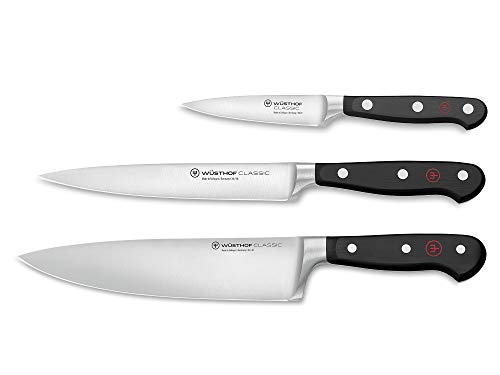
 Wüsthof Classic 3-Piece Chef's Knife Set (Black Handle)
 Wüsthof Classic 6-Piece Chef's Knife Set (Black/Silver)
 Wüsthof Classic 6 Inch Cleaver (Black Handle, 16cm Blade)
 Wüsthof Classic 3-Piece Starter Knife Set (Black Handle)
 Wüsthof Classic 2-Piece Chef's Knife Set (Black Handle)
 Wüsthof Performer Carver 26cm (Black)
Johann Abraham Wüsthof opened his shears factory in Solingen in 1814 and the business is still owned by the family, now run by the seventh generation. Solingen is known as the City of Blades and the trident logo on every knife has been a registered trademark since 1895. That long history matters less than what it means in your hand: a solid, well balanced knife that can take a knock, doesn't chip easily and stays in service for decades.
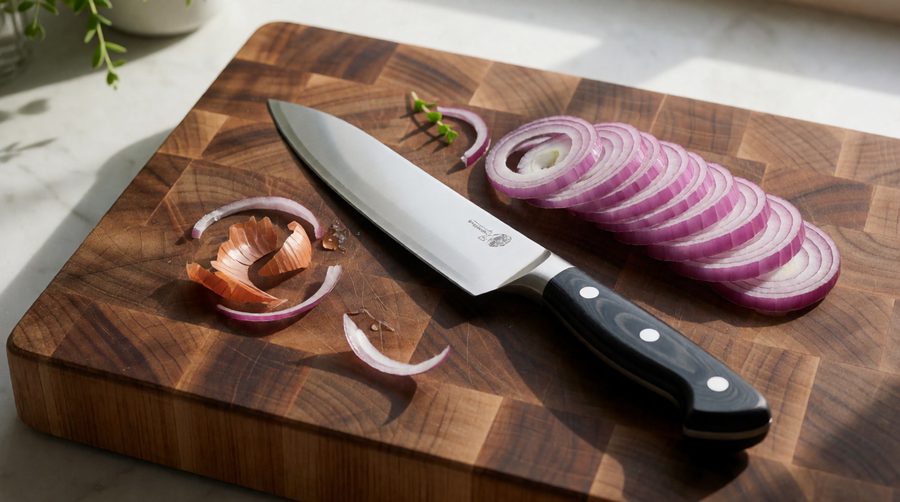
A chef's knife does more work than any other blade in the kitchen. The European shape has a pointed tip and a gently curved edge, so you can rock it through herbs, slice onions, crush garlic with the flat and carve a roast chicken without swapping tools. That's why Wüsthof's 20cm Classic has been one of the most popular kitchen knives with home cooks and professional chefs for years.
Every forged Wüsthof knife is made from X50CrMoV15, a high carbon stainless steel with chromium, molybdenum and vanadium. It's hardened to 58 on the Rockwell scale. That's softer than most Japanese steel, but it makes the edge tough and easy to sharpen. The edge is then put on by Precision Edge Technology (PEtec), a computer-guided process that Wüsthof says makes it 20 percent sharper with twice the edge retention of its older knives.
The brand sells several ranges and the names are easy to mix up. All the forged ones share the same steel, the same 58 HRC hardness and the same 14 degree angle on each side. What changes is the handle, the bolster and how the blade is made.
The best seller. A full tang runs through a black POM (polyoxymethylene) handle held with three rivets, and a full bolster at the heel guards your fingers. The Classic chef's knife is the one most people picture when they think of German kitchen knives, and the 20 cm Classic chef's knife is Wüsthof's top-rated blade.
Same steel as the Classic, but with a curved, more ergonomic POM grip, a second bolster at the end for balance and a half bolster at the heel. As nothing runs down to the edge, you can sharpen its whole length and use a pinch grip comfortably.
The Ikon design with a handle made from African blackwood (grenadilla) instead of synthetic material. It's the premium range and costs noticeably more than Classic Ikon.
Gourmet blades are laser-cut from a sheet of steel (stamped) rather than forged. There's no bolster, so they're lighter and cheaper, which suits a first good knife or a busy family kitchen.
Performer knives have a black DLC coating on the blade and a hexagon power grip handle. Crafter has smoked oak handles with brass rivets, aimed at people who love a rustic, wooden look.
| Range | Blade | Handle | Bolster | Best for |
|---|---|---|---|---|
| Classic | 58 HRC, 14 degrees | Black POM, triple riveted | Full | Everyday cooking and first-time buyers |
| Classic Ikon | 58 HRC, 14 degrees | Curved POM, double bolster | Half | Pinch grip users who sharpen at home |
| Ikon | 58 HRC, 14 degrees | African blackwood | Half | A premium knife to keep for life |
| Gourmet | Laser-cut stamped | Synthetic | None | Lighter knives at a lower price |
| Performer | DLC coating | Hexagon power grip | Varies by model | Cooks who want something different |
| Crafter | 58 HRC | Smoked oak, brass rivets | Varies by model | A warm wooden look in the kitchen |

Wüsthof says a forged blade goes through more than 40 steps in its factory, while a laser-cut stamped blade goes through 14. Forging gives you the bolster, which adds weight and balance, plus a thicker spine that feels planted on the chopping board. Stamped Gourmet knives are lighter, more flexible and cheaper.
For a chef's knife used every day, forged is worth paying for. If you mostly cook simple meals or want to kit out a whole kitchen on a tighter budget, a Gourmet set does the job well. Our budget chef knives have more options at lower prices.
Wüsthof makes its chef's knives in lengths from 12 cm up to 26 cm, and the Classic chef's knife comes in more sizes than any other range. Pick the size that suits your hands, your board and what you cook.
Some sizes also come with a hollow edge: a row of shallow scallops along the side that stop slices of potato, cucumber or cheese sticking. The 20 cm Classic chef's knife with hollow edge is one. Prefer a flatter blade for push cutting? A santoku is the Japanese-style all-rounder, and Wüsthof makes Classic santoku knives with a hollow edge in 14 cm and 17 cm.

Here's how some of the Wüsthof knives and sets on this page compare, using the specs listed for each one.
| Model | Range | Chef's knife blade | What you get | Key specs |
|---|---|---|---|---|
| Classic Ikon Chef's Knife 1040330120 | Classic Ikon | 20cm | Single knife | 58 HRC, 14 degree edge, satin finish |
| Classic Ikon Chef's Knife (Crème) 1040430123 | Classic Ikon | 23cm | Single knife | Crème POM handle, PEtec edge |
| Classic Ikon 10 Inch Chef's Knife 1040330126 | Classic Ikon | 25.4cm | Single knife | 14 degrees per side, 58 HRC |
| Ikon 6 Inch Chef's Knife 1010530116 | Ikon | 16cm | Single knife | 136g, PEtec edge |
| Classic 3-Piece Chef's Knife Set 1120160301 | Classic | 20cm | Chef's, utility and paring knives | Triple riveted, 544g total |
| Classic 2-Piece Chef's Knife Set 1120160206 | Classic | 20.3cm | Cook's and paring knives | 58 HRC, 386g total |
| Gourmet 3-Piece Chef's Knife Set 1125060307 | Gourmet | 20.3cm | Chef's, utility and paring knives | Laser-cut, 470g total |
| Classic 6 Inch Cleaver 1040102816 | Classic | 16cm cleaver | Single cleaver | 460g, triple riveted |
If you need more than one blade, a set is usually cheaper than buying each knife on its own. Most cooks only use three knives regularly: a chef's knife, a paring knife and a serrated bread or utility knife. A 2 or 3-piece set covers those. Bigger block sets add carving, boning and steak knives, a honing steel and storage.
Check what's actually in the box before you buy. Some sets have a 16cm chef's knife rather than a 20cm one, and a block takes up worktop space that a magnetic strip doesn't. Compare more makers in our chef knife sets.
German knives like Wüsthof use softer, tougher stainless steel and a slightly thicker blade. Japanese knives are usually harder (61 HRC and up), thinner and sharper out of the box, but they can chip on bones or frozen food and need more careful sharpening. A Wüsthof chef's knife is the safer choice if you want something that copes with a busy kitchen, the odd knock and a busy family kitchen.
Zwilling is the closest rival. It's also from Solingen, with similar ranges and prices, so the choice often comes down to which handle feels better to you. See our Zwilling Pro chef knives to compare. If you'd prefer a lighter, all-steel Japanese knife, look at Global knives or our wider range of Japanese chef knives.
The edge on these knives is tough, but every blade goes dull with use. Hone it with a steel every few sessions to straighten the edge, and sharpen it properly when honing no longer brings it back. A whetstone around 1000 grit works well on 58 HRC steel, and so does a good hand-held or electric sharpener set to 14 degrees. Find one in our professional knife sharpeners.
Look after it like this and a forged German chef's knife can last a lifetime. Wüsthof backs its knives with a limited lifetime warranty against manufacturing defects.
For most home cooks, yes. You're paying for forged Solingen steel, a well balanced handle and a limited lifetime warranty. A single 20 cm Classic chef's knife will handle almost every kitchen job for many years.
The blades are the same steel, hardness and edge angle. Classic has a straight triple-riveted handle and a full bolster. Classic Ikon is curved, with a half bolster at the heel, which makes it easier to sharpen and to hold in a pinch grip.
In Solingen, Germany. Wüsthof says it's one of the few makers allowed to stamp "Made in Solingen" on its knives, a label protected by law since 1938.
It's the year the knife was made. Add "20" in front of the two digits, so 24 means 2024.
Wüsthof recommends hand washing. Heat, detergent and other items knocking against it dull the edge and can damage the handle.
Yes. In the UK it's illegal to sell a knife to anyone under 18, and Amazon checks your age on delivery. The gov.uk guide to buying and carrying knives explains the rules.
You can read more about the company's history on the Wüsthof website or on Wikipedia. Still deciding? Our top rated chef knives, sharpest chef knives and premium chef knives are worth a look too.