Wüsthof Ikon 6-Piece Knife Block Set (Black)
 Wüsthof Classic 6-Piece Chef's Knife Set (Black/Silver)
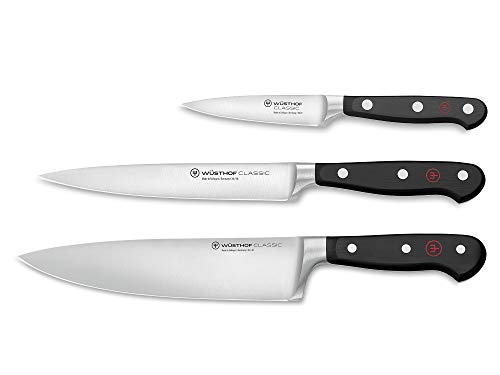 Wüsthof Classic 3-Piece Chef's Knife Set (Black Handle)
 Dalstrong Gladiator Series Elite 12-Piece Knife Block Set (White Handles)
 Zwilling Four Star Self-Sharpening (Brown Ash Block, 7-Piece)
 Wüsthof Classic Ikon Steak Knife Set (Black, 4-Piece, 11cm)
A star rating tells you one thing above all: how happy people were after they'd used the knife at home. That's useful, because a chef knife only shows its true colours after a few weeks of onions, carrots and Sunday roasts. A blade that chips, a handle that rubs or an edge that fades fast soon drags the score down.
So a knife that holds 4.7 stars across a couple of thousand ratings has passed a pretty tough test. It's not proof that it's the perfect knife for you, though. To get the most from the ratings, it helps to know how they're worked out and what they can't tell you.
Amazon doesn't use a simple average. Its system leans on three things:
A knife whose edge has gone downhill in newer batches will usually see that show up in its score fairly quickly.
Five stars from three people means very little. In this range, the Kokoro Kiritsuke sits on 3.4 stars from just three ratings, while the Global G-2 has 4.7 from 2,768. Look for 4.5 stars or more backed by at least a few hundred ratings. That's where the score settles down and stops swinging on one happy or grumpy buyer.
Here's a quick way to size up any chef's knife on its rating:
Amazon often groups sizes and colours under one listing, and they share the same reviews. That's why the Wüsthof Classic Ikon 8 inch, 9 inch and 10 inch chef's knives all show 4.7 stars from exactly 1,391 ratings in our feed. Most of those reviews will be for the popular 8 inch, so if you're buying a less common size, read a few comments to check people are talking about the one you want.
Since 6 April 2025, it has been illegal for businesses to post or pay for fake reviews, or hide paid-for reviews, under the Digital Markets, Competition and Consumers Act. The Competition and Markets Authority can now fine firms directly. You can read more in the GOV.UK announcement on the fake reviews ban. It doesn't make every score perfect, but it does mean the scores on big names like Wüsthof and Zwilling are far more trustworthy than they once were.
We've pulled these figures straight from our product feed: the star rating and number of ratings on Amazon when we last checked, plus each knife's own specs. Ratings move over time, so check the product page for the latest score before you buy.
| Knife | Rating | Ratings | Blade | Hardness | Edge | Weight |
|---|---|---|---|---|---|---|
| Global G-2 Cook's Knife | 4.7★ | 2,768 | 20cm | 56-58 HRC | 15° | 222g |
| Zwilling Professional S 3-piece (chef's knife) | 4.7★ | 2,568 | 20cm | Ice-hardened | Not stated | 257g |
| Wüsthof Classic Ikon 8 inch | 4.7★ | 1,391 | 20cm | 58 HRC | 14° | 340g |
| Wüsthof Classic Ikon 10 inch | 4.7★ | 1,391 (shared) | 25.4cm | 58 HRC | 14° | 400g |
| Global G-5 Vegetable Chopper | 4.7★ | 826 | 18cm | Not stated | Not stated | 272g |
| Wüsthof Classic 6 inch Cleaver | 4.8★ | 591 | 16cm | 58 HRC | Not stated | 460g |
| Global G-46 Santoku | 4.6★ | 479 | 18cm | Not stated | 15° | Not stated |
| Global G-80 Santoku (fluted) | 4.6★ | 459 | 18cm | Not stated | 15° convex | 178g |
| Wüsthof Ikon 6 inch | 4.5★ | 241 | 16cm | 58 HRC | Not stated | 136g |
| Wakoli EDIB Damascus set | 4.7★ | 328 | 20cm (chef's) | 60±2 HRC | 15° | Set 500g |
A few patterns jump out. The Japanese-style Global knives are the lightest by a long way, with the G-2 at roughly two thirds of the weight of the Classic Ikon. The German knives sit on a steady 58 HRC and carry more heft for heavy chopping. And the three most-reviewed single knives are all 20cm blades, which tells you what size most cooks end up choosing.


Star ratings come from everyday cooks. Professional reviews come from people who line up dozens of knives and use them side by side, chopping carrots, slicing tomatoes and dicing onions. The best sign of all is when both agree, and a handful of names come up again and again in the guides that rank on Google:
Wirecutter names the Wüsthof Classic Ikon 8 inch as its pick for a classic German knife, and KitchenKnifeGuru recommends the Classic Ikon santoku. Wüsthof has been making knives in Solingen, Germany, since 1814. The Classic Ikon is fully forged with a half bolster, so you can sharpen right down to the heel, and the contoured handle is one of the comfiest around. It's also one of the top rated chef knives in our range with buyers. You'll find the whole family in our Wüsthof chef knives.
Zwilling J.A. Henckels, founded in Solingen, Germany, in 1731, is the other big German name. KitchenKnifeGuru puts the Zwilling Professional S 8 inch first on its list as the most indestructible choice. It's forged from one piece of steel and ice-hardened using Zwilling's FRIODUR process. Have a look at our Zwilling Pro chef knives for more from the range.
Global's all-steel knives are made in Japan and have been around since 1985 (the 15cm Small Kiritsuke in this range is a 40th anniversary edition). KitchenKnifeGuru picks the Global santoku as its light and nimble choice. The hollow handle is filled with sand to balance the blade and has a dimpled grip. See every model in our Global chef knives.
These Japanese makers turn up in almost every big test. Wirecutter's favourite is the Mac MTH-80, a dimpled 8 inch chef knife it has used for years, with the cheaper Tojiro F-808 as runner-up. Bon Appétit tested 42 chef's knives and also put a Mac first, with the Shun Classic 8 inch close behind. They're thinner, harder and lighter than German knives. If that's the style you're after, our Japanese chef knives are the place to start.
On a tighter budget, testers point to Victorinox and Mercer. Wirecutter's budget pick is the Victorinox Swiss Classic 8 inch, and Bon Appétit's is the Mercer Renaissance. Both have stamped blades and plain handles, but they arrive sharp and are easy to bring back with a sharpener. The Victorinox Swiss Classic 7-piece set in this range holds 4.8 stars, and our budget chef knives have plenty more.
Almost every guide to the best chef's knife splits them this way, and with good reason. The two styles feel very different in the hand.
Not sure? Plenty of chefs own one of each: a German knife for heavy jobs and a Japanese blade for precise prep.
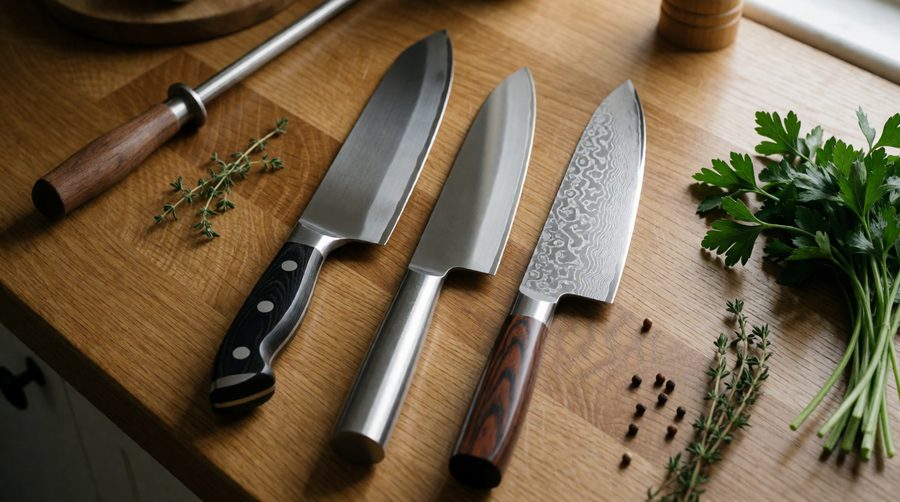
The blade length decides what a chef knife feels like to use day to day:
Weight is personal. A light chef knife like the Global G-2 (222g) feels quick and nimble, while the 340g Classic Ikon lets its weight do the work on dense veg. Hold it with a pinch grip at the bolster. If it tips hard towards the tip or the handle, it'll tire your wrist on a long prep session.
Forged blades are hammered from a single piece of heated steel and usually have a bolster where the blade meets the handle. Stamped blades are cut from a sheet, so they're lighter and cheaper. Both can be excellent: the forged Wüsthof and the stamped Victorinox are both on Wirecutter's list.
You'll see three main steels on a chef's knife:
Harder steel (60 on the Rockwell scale and up, like the VG-10 in the Wakoli knives) stays sharp for longer but is more brittle. Softer German steel from Solingen bends a little rather than chipping, so it forgives the odd careless moment.
The handle is the part you hold for an hour of prep, so it matters as much as the blade.
Pick the handle that feels secure when your hand is wet, and check the balance point sits near where your fingers pinch the blade.
You don't need to spend a fortune: many highly rated knives cost less than a meal out. If you'd like something special as a gift, our expensive chef knives and Damascus knives are where the showpieces live.

Sets get some of the biggest review counts in this range. The Zwilling Gourmet 7-piece block holds 4.5 stars from 6,902 ratings, and the Paudin 14-piece set 4.6 from 4,423. The Zwilling Professional S 3-piece is a great middle ground: a 20cm chef's knife, a 16cm slicer and a 10cm paring knife, which covers nearly everything most cooks need:
Big block sets look like good value, but you'll probably use three knives every day and leave the rest in the block. Our advice is to buy one great chef's knife first, then add a paring knife and a bread knife. If you'd rather have it all in one go, browse our chef knife sets.

Even the top rated chef knives lose their edge if they're treated badly, and a lot of one-star reviews come from knives that went in the dishwasher. A few simple habits keep yours sharp for years.
Our professional knife sharpeners include whetstones, pull-through sharpeners and honing rods to suit every knife here.
A sharp knife is actually safer than a blunt one, because it goes where you aim it instead of skidding off a tomato skin. Curl the fingertips of your guiding hand under and keep the blade against your knuckles. If you do catch yourself, the NHS advice on cuts and grazes explains how to clean and cover a small wound and when to get help.
Buying a chef's knife as a present? It's illegal to sell most knives to anyone under 18 in the UK, and there are rules on carrying knives in public. The GOV.UK guide to buying and carrying knives sets them out.
No single knife wins every list, but the Wüsthof Classic Ikon 8 inch is one of very few that's highly rated by both buyers (4.7 stars from 1,391 ratings when we checked) and professional testers. The Global G-2 has the most ratings of any single knife in our range, also at 4.7 stars.
Aim for 4.5 stars or more from at least a few hundred ratings. Below that, one or two reviews can push the score up or down a long way.
Neither is better overall. German knives are tougher and heavier, while Japanese knives are thinner, harder and lighter for precise slicing. Choose the style that suits how you cook.
A 20cm (8 inch) blade suits most cooks and is the size most buyers choose. Go for 16cm for smaller hands or a 25cm blade for big batches.
Some makers say theirs can, but hand washing keeps the edge and handle in better shape for much longer. Many of the low ratings on good knives come from dishwasher damage.
For most people, one quality chef's knife plus a paring knife and a bread knife is better value than a big block. Sets make sense if you're kitting out a new kitchen in one go.