Pick up a Global knife for the first time and the weight is what surprises you. There's no wooden handle, no rivets and no heavy bolster, just one smooth line of stainless steel from tip to heel. Inside, it's hollow and filled with just the right amount of sand to balance the steel, so the knife feels light but steady in your hand.
That design came from the industrial designer Komin Yamada, who was asked by Yoshida Metal Industry (better known as Yoshikin) to create something new for its range. The first Global knives went on sale in 1985 and the shape has barely changed since. Professional chefs took to them quickly, with names such as Anthony Bourdain and Michel Roux Jr among the fans. Home cooks soon followed.
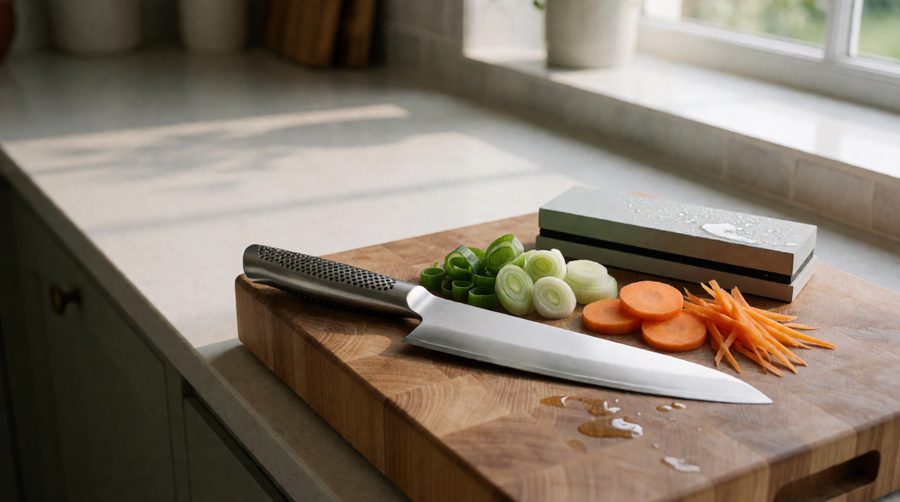
Compared with heavier European knives from makers like Wusthof or Zwilling, a Global blade is thinner and harder. Each side is sharpened to around 15 degrees, which is more acute than most Western kitchen knives, so it glides through tomatoes and herbs rather than pushing them about.
Every Global knife uses Cromova 18, a stainless steel the company developed for its own knives. The name tells you what's in it. "Cro" is chromium, "mo" is molybdenum, "va" is vanadium and the 18 is the percentage of chromium. That high chromium content is why the blades resist staining so well.
The steel is ice tempered and hardened to 56 to 58 on the Rockwell scale. That's hard enough to hold a keen edge for a long time. It's also soft enough that sharpening at home isn't a chore, which suits a busy kitchen.
Most knives in the Classic range are made from pressed Cromova 18 with the hollow grip welded on and polished so it looks like one piece of stainless steel. There are no joins for food to collect in, which makes them very hygienic. The heavier GF series is drop forged for chefs who want more weight behind each cut.

Global sells several ranges. It helps to know how they differ before you buy. All of them share the same Japanese steel and the dimpled pattern, but the thickness, shape and finish change.
The original Global range, with the black dots on the handle. It's split into series by size and job. The G series holds the larger knives with hollow grips, including the best-selling G-2 cook's knife. The GS series covers small to medium knives such as paring and utility knives. GF knives are the forged, heavier professional models and the GSF series is made up of small knives with solid handles for peeling and detail work.
Launched in 2015 (Ni means two in Japanese), the Ni range was designed with professional chefs in mind. Ni blades are slightly thicker and heavier than the Classic series. A longer handle gives better balance in a pinch hold over a long shift. The dots are pared back to a slim strip too.
Ukon knives have thicker blades again and get extra grinding and finishing, which Global says makes them 10 percent sharper out of the box. Each one has a smooth top, a textured underside and a thumb rest that sits close to the edge, so they suit cooks who like firm control.
Sai is the most premium range, also designed by Komin Yamada. The blades are three-ply steel with a hammered finish that helps food slide off. A thumb recess gives you a secure hold.
| Range | Blade | Handle | Best for |
|---|---|---|---|
| Classic (G, GS, GF, GSF) | Thin, light, 15 degree edge | Hollow and sand-weighted with black dots | Everyday cooking and first-time buyers |
| Ni | Slightly thicker and heavier | Longer, slim strip of dots | Long prep sessions and pinch grip users |
| Ukon | Thicker, extra fine grinding | Dual surface with thumb rest | Cooks who want a firmer, steadier feel |
| Sai | Three-ply, hammered finish | Thumb recess | A show-piece knife that gets used every day |

If you only buy one, make it a chef's knife. A 20cm Global cook's knife like the G-2 will chop onions, slice chicken, crush garlic and shred herbs, so it covers most of what you do on a chopping board. Smaller hands might prefer a 16cm or 18cm length, which feels nimbler.
Prefer a straighter edge for push cutting? A santoku knife is the Japanese all-rounder, with a flatter blade and a rounded tip. The fluted G-80 has scallops that stop thin slices sticking. A paring or utility knife makes a handy second blade for peeling and trimming, then a bread knife and a carving knife finish off a well-rounded kit.

Here's how some of the Global knives in our range compare, using the details listed for each model.
| Model | Range | Type | Blade length | Good for |
|---|---|---|---|---|
| G-2 | Classic | Cook's knife | 20cm | All-round chopping and slicing |
| G-80 | Classic | Fluted santoku | 18cm | Vegetables and thin slices |
| GS-110 | Classic (40th Anniversary) | Small kiritsuke | 15cm | Fish, meat and precise veg prep |
| G-18 | Classic | Flexible filleting knife | 24cm | Filleting whole fish |
| GU-01 | Ukon | Chef's knife | 20cm | Heavier everyday prep |
| GU-03 | Ukon | Bread knife | 22cm | Crusty loaves and soft fruit |
| GN-008 | Ni | Oriental cook's knife | 16cm | Precise cuts with a pinch grip |
| GF-31 | Classic GF | Boning knife | 16cm | Meat and poultry |
| Sai-06 | Sai | Cook's knife | 25cm | Big batches and large veg |
A Global knife set is often the easiest way to start your own range of knives and it usually works out cheaper than buying each blade on its own. Look at what's actually inside before you choose. A three-piece set with a cook's knife, a vegetable knife and a paring knife covers most cooking, while bigger sets add a bread knife, a carver or a boning knife.
Think about storage as well. Sets come with a knife block, a magnetic rack or a slim dock. Any of them is kinder to the edges than a drawer. You'll find more choice from other makers in our chef knife sets.

With such a narrow angle, Global recommends whetstones and ceramic sharpeners for sharpening rather than the traditional European steel. A quick few passes on a ceramic rod every few sessions realigns the edge. When the knife starts to feel dull, a whetstone around 1000 grit brings it back. A finer stone then polishes it.
Water-wheel sharpeners like MinoSharp are a simple option if you don't fancy freehand sharpening, as they hold the knife at the right angle for you. Sharpening little and often is far easier than rescuing a very blunt Japanese edge. Avoid cheap pull-through sharpeners with fixed carbide slots, which can chew up a fine 15 degree edge. Browse our professional knife sharpeners to find one that suits your knives.
Look after a Global knife this way and it should last for many years. Global UK also offers a warranty on its knives, so it's worth keeping your proof of purchase.
Global knives sit between heavy German knives and the very hard, thin Japanese knives made by small workshops. They're sharper and lighter than most Western kitchen knives but tougher and easier to care for than many carbon steel blades. That's why so many professional chefs keep one on the pass.
If you'd like a patterned blade, take a look at our Damascus knives. Want the keenest edge you can get? Our pick of the sharpest chef knives is a good place to start. Our premium chef knives include some of the finest Japanese blades around.
For most home cooks, yes. They're light, sharp, very hygienic and easy to sharpen. A single good chef's knife from Global can last for decades with basic care. Some keen knife collectors move on to harder carbon steel later, but plenty of chefs stick with Global for life.
Global knives are Japanese through and through. Yoshikin still makes every one at its factory in Niigata prefecture, where the brand began in 1985.
Hand washing is recommended. The heat, strong detergent and other items rattling against the blade will dull the edge over time.
They're hollow stainless steel. Global fills each one with a measured amount of sand so the knife balances properly without needing a heavy bolster or full tang.
Yes, in the UK it's illegal to sell a knife to anyone under 18. Amazon and other retailers check your age on delivery. The gov.uk guide to buying and carrying knives explains the rules.
The Ni knives are a little thicker and heavier than the Classic range with longer handles, which suits long prep sessions. Global Classic knives are lighter and the best known.
You can read more about the brand's history on Wikipedia or browse the full line-up on the Global Knives UK website. Still deciding? Our top rated chef knives and budget chef knives are worth a look too.